The Best Time to Start, and the 20 Page Contract You Don't Need.
Why the divide between builders and daydreamers is rarely capital, and how subtracting legal friction creates unstoppable speed.
"A startup has neither the legal budget nor the executive bandwidth to enforce a complex distribution agreement. You deliver against a clean Purchase Order and get out of their way."
Whenever someone asks me when they should finally leave the safety of an enterprise salary to build their own company, they usually expect an equation.
They want to discuss macroeconomic cycles, interest rates, capital availability, or whether they should wait until their savings account touches an arbitrary milestone. They treat timing like an astrological transit. If they only stare at the calendar long enough, the heavens will open, a choir will sing, and the universe will announce that risk has magically dropped to zero.
My answer to all of them is always identical: the best time to start is now.
Almost every ambitious professional toys with the idea of building a venture at least once. It hits you during an excruciating quarterly review, or while watching an indecisive corporate committee take six months to approve a modest software budget. You sit in your cubicle, sketch out an idea on the back of a notepad, and realise that you could build this better, faster, and cleaner.
Yet ninety-nine percent of people never take that step.
The divide between those who build and those who merely deliberate is rarely intelligence, pedigree, or access to venture capital. The only difference is that some people simply decide to take the first stride, fully accepting that they will learn the craft while taking honest punches on the chin.
The Comfort of the Whiteboard
Taking the leap requires strict honesty about what you actually want. Daydreaming is comforting because daydreams never fail. A company that exists only in your imagination does not suffer cash-flow shortfalls, server downtime, or enterprise clients who delay disbursements by sixty days.
Years ago, I worked for a boss who remains one of the sharpest strategic minds I have ever encountered. Every few months, he would arrive with a fresh idea and talk me through a brilliant business plan. We would sit together, flesh out every detail until the numbers stood upright, and then quietly drop it a few weeks later.
He was someone who found genuine peace in stability. The prospect of stepping into the unpaved wild, with no corporate buffer and no predictable pay cheque arriving on the first of the month, paralysed him.
Does that make him any less capable? Not at all.
In fact, he became an extraordinary advisor to growing ventures because he possessed the rare gift of inspecting operational chaos, identifying structural bottlenecks, and installing disciplined governance. Not everyone is built to be the founder who jumps off the cliff with raw momentum. Some individuals are built to design the parachute once the aircraft is already airborne.
The trouble begins when founders confuse the two disciplines.
The Twenty-Page Contract Illusion
In the early days of building SmarterHomes Technologies, we were preparing to onboard regional channel partners to scale our residential sub-metering footprint across India. Like many first-time founders eager to project institutional legitimacy, I convinced myself that we required heavyweight legal infrastructure.
I picked up the phone and dialled that very same former boss, asking if he had a standard multi-tier channel partner agreement I could adapt.
He paused for a moment and asked me what I was genuinely trying to achieve with a legal document of that weight.
I recited every corporate cliché I had absorbed during my business-school days. I explained that we needed to protect our brand equity, safeguard intellectual property, restrict territorial encroachment, and guarantee that distributors did not misrepresent the technology.
He chuckled softly and shared a piece of counsel that permanently altered my perspective on operational friction:
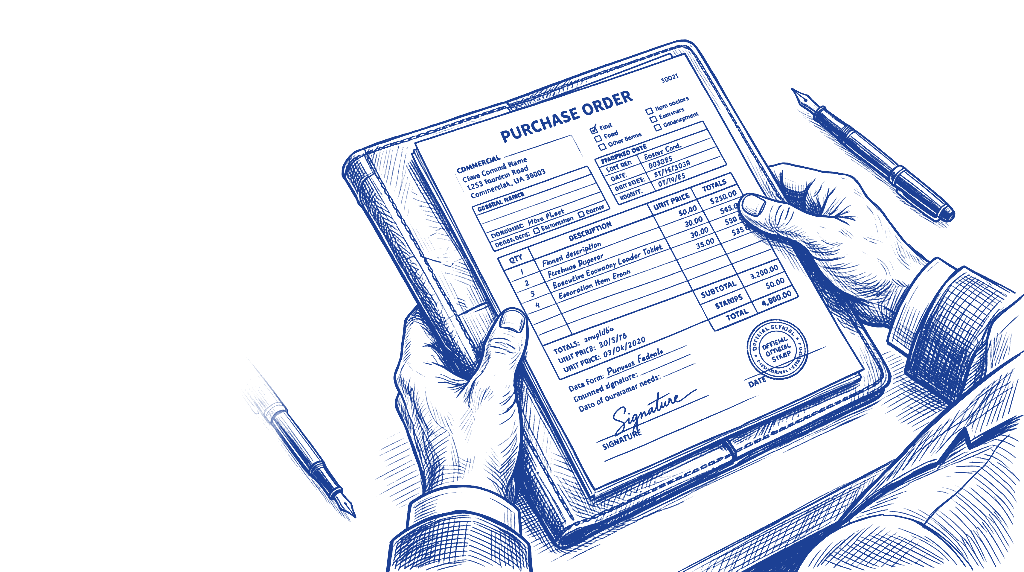
Do not even think about drafting a twenty-page contract. Deliver the hardware against a clean, commercially stamped Purchase Order, and give your partners the complete freedom to sell however they wish.
It sounded almost reckless to my corporate-trained instincts. In practice, it was pure operator genius.
An early-stage startup possesses neither the legal war chest nor the executive bandwidth to enforce an exhaustive non-exclusive distribution contract across four regional territories. Because we kept our distribution frictionless, operating purely on commercial Purchase Orders rather than convoluted channel agreements, our institutional due diligence sailed through in weeks rather than bogging down in months of contentious contract renegotiations and disclosure schedules.
We had deliberately refused to borrow future complexity before earning the right to carry it.
The Power of Chalk Over Stone
When you start with the bare minimum, you are blessed with an empty slate.
A clean whiteboard is often a founder’s quietest and most forgiving ally.
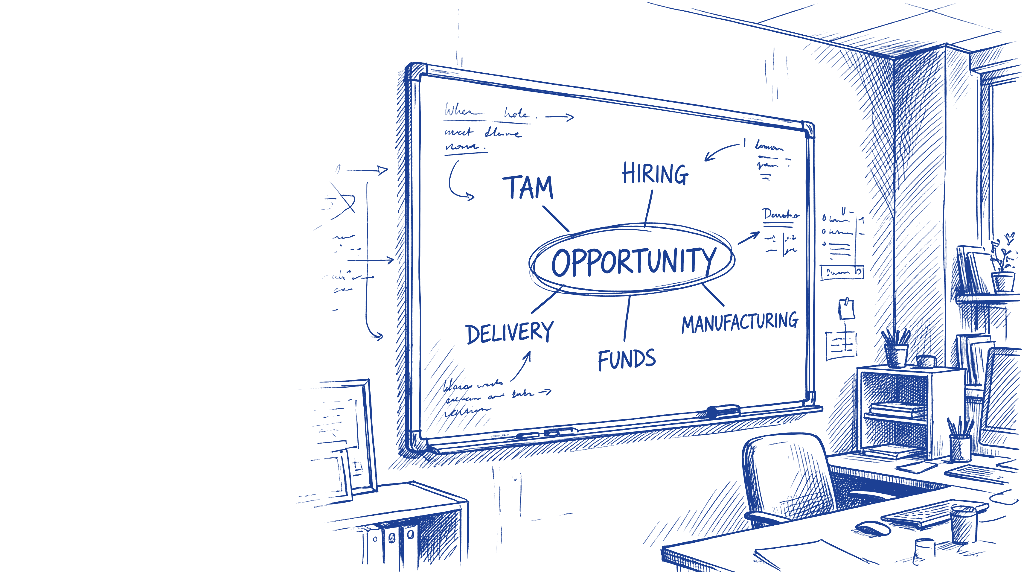
An established enterprise writes everything in wet concrete. Formal policies, approval matrices, reporting lines, and procurement gatekeepers clutter every corridor. By the time the concrete cures, changing direction requires a jackhammer and three quarters of board deliberations.
When you start small, your entire venture is written in chalk. You can draft an operating hypothesis on Monday morning, test it against real customer feedback by Wednesday afternoon, and erase it completely by Friday night without consulting a single steering committee.
You do not begin with policies; you begin with decisions. You do not begin with handbooks; you begin with direct conversations with the person signing the cheque. Because your processes are still evolving organically, keeping your slate free of permanent ink gives you the agility to adapt before capital runs dry.
-
The Freedom to Erase: Stone demands permanence before conviction has had time to mature. A whiteboard invites you to test an assumption, look it in the eye, and wipe it away without remorse when reality pushes back.
-
The Hazard of Pristine Plans: It is easy to confuse a tidy presentation with a viable enterprise. Elaborate spreadsheets often serve as a polite hiding place from the discomfort of speaking to actual customers.
-
Temporary Architecture: Treat every early strategy as temporary scaffolding rather than permanent foundation. Build just enough structure to take the very next step, and leave the monumental masonry for later.
-
The Discipline of Starting: Execution does not wait for absolute certainty. The real work begins not when the plan is polished, but the moment you pick up the phone and commit yourself to the rough edges of reality.
Evolving Beyond the Startup Label
There is an alluring trap in early enterprise romance. Far too many founders fall in love with the theatre of being an underdog. They celebrate casual clothes, shared desks, late-night pizza marathons, and the self-indulgent identity of a perpetual experiment.
They treat early inefficiency like a badge of honour.
The founders who survive and build enterprises that endure do something radically different. They begin with raw, unapologetic energy, but they quickly stop treating their business like a cute university project. They treat it with commercial dignity and rigorous fiscal discipline from day one.
They do not waste hours on performative operations. They do not draft thirty-page distribution contracts when a clean Purchase Order solves the client’s problem. They do not track twenty vanity metrics on an analytics dashboard when three cash-flow lines tell the unvarnished truth. And they never wait for macroeconomic conditions to turn favourable before picking up the telephone.
If you are sitting at your desk today waiting for the ideal moment to build, recognise that conditions will never be flawless. Markets will always appear unsettled, your capital cushion could always be larger, and there will always be a sensible corporate excuse to postpone for another quarter.
Take the first step. Keep the slate clean, write in chalk, and leave the heavy legal binders on the shelf.
The only things that truly matter are the customer on the line, the working product in the crate, and the quiet clarity to strip away everything else.
Connected Note: Simplicity is not the absence of ambition; it is the ruthless elimination of administrative theatre so execution can breathe.

Advisor, operator, and storyteller with Lucknow roots. Decades of building category-creating enterprises and navigating life with patience taught him the quiet power of simplification.
Join the Discussion on X
Have thoughts, a contrasting view, or battle scars of your own? Join the conversation on X. Zero spam, real perspectives.